| A big topic amongst vintage collectors and
drum restorers is why many of the major drum companies painted
the interiors of their drum shells. One of the biggest question
is if they did it for the sound. My opinion is it was never
a sound issue but a way to cut corners. Basically it would take
less time to make the interior as nice as the exterior and also
it was a way to cover up imperfections in the ply material.
This saved time and money and allowed them to build drums faster.
So, can we now say that the interior of a drum is affected
by the interior finish? I would say yes, but the sound to most
ears is probably not that noticeable.
So, the question to a vintage historian and a vintage collector
is will the drum value change if they repaint the interiors
of vintage drums. The answer of course is multi faceted, but
in general as soon as you alter an original vintage drum then
it lowers the value.
So when is it a OK? Well, the debate has raged on in many forums
and there are two sides that will fight this until the sun goes
down, but if you have a set of drums, they are your drums and
you can do whatever you want to do to them.
So, if they are really beat up, been altered, painted over
or if you are taking orphan drum shells and trying to make a
complete matching kit then it is time to start painting! The
next thing to figure out is what paint to use for the drums
you have.

| Ludwig
White Interiors - Benjamin
Moore Regal Semi Gloss Finish N333 (Formerly - Benjamin
Moore Aqua Glo White) |
 |
| Just to make it very clear, with Ludwig drums there
are transition shells that might not fit these dates with
a different ply make-up. Also, on drums with wood finished
exteriors that were lacquered then the exterior ply would
normally be maple. This is not an exact science and the
cross over drums between changes add a twist to the history
of Ludwig. |
| Ludwig Shells |
Basic shell information 3-Ply Shells |
Shell Material |
Interior |
| 1960 |
|
Mahogany/Poplar/Mahogany |
Clear Lacquer |
| 1961-1967? |
|
|
White Paint |
| 1968 |
Switched to clear interiors and also the baseball bat
mufflers |
Mahogany/Poplar//Maple |
Clear Interior |
| 1976 |
3ply shells switched to 6 ply shells some time in 1976-77 |
|
|
| Ludwig Date Stamps |
| Date stamping started around 1956 with larger numbers
and letters in red ink, then in 1961-1962 stampings were
still red, but with slightly smaller characters. In 1963
shells can be found with red or black ink stamps. (Rob
Cook) |
| Gretsch
Silver Interiors - Galvanized
Fence Paint |
|
| Just like Ludwig, Gretsch had transition times when
shells are used up or sealer was added. So there are exceptions
to the below timeline. This is not an exact science and
the dates can be challenged by these anomalies. |
| Gretsch Shells |
Basic shell information |
Shell Material |
Interior |
| Pre Mid 50's |
3-ply shells |
|
Clear |
| 1957, 58 - ? |
Jaspar Shells 6-ply |
|
Silver Sealer |
| |
|
|
|
| |
|
|
|
| |
|
|
|
| |
|
|
|
| Gretsch Paper Tags |
| There has been a lot of discussion about this and some
contradicting information. But the general consencus is
that the paper tags started some time around 1962 or 1963. |
Slingerland
Tan Interiors -
It was generally
sprayed on, with thickness varying quite a bit from so thin
as to be barely noticeable to so thick as to be completely
opaque. Due to this thickness variation the appearance and
shading of weak chocolate varied also. DrCJW |
Paint configuration coming soon.. |
We already have an extensive history section about
the shells and ply-configuration on Slingerland Drums
by DrCJW... All of this info comes from the forum and
post by DrCJW..
The tan interiors were from 1966-1970. Click here to
visit the Slingerland
History Section. |
| Slingerland Stamps |
| Slingerland used standard off-the-shelf rubber date stamps.
This particular one, still available today, has rubber wheels
with selectable date in month-day-year format, such as JUN
15 1966. The day wheels both contain an X character. If
the guy in the shell room decided to include the day in
the stamp, he did. If he didn't care about the day, he might
just use the X. Or he might use the dash -, which is also
standard on the wheel, and which we also often see on 60's
Slingerland shell interiors. Taken from DrCJW post on vintagedrumforum.com |
| Caution:
Make sure your interiors are the correct
color and not faded. If you want an exact match to your
interiors, take the drum to the paint store. |
 |
Original Shell Interior |
| Click image for
Larger Photo |
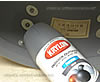
Rogers
Gray -
Krylon flat gray primer |
Very close match to the original finish |
Rogers
Granitone Interiors - Zolatone
Info from Marley
|

|
Silver Gray 20-72 |
| |
Rogers
Granitone Interiors - Trunk
Spray
Info from TommyP
|
|
Gray - White |
| Web
Site |
Special note: Wood Dynasonic snare drums,
from the first one in 1963 up to when they were discontinued
in 1973... (although Rogers came out with the NEW wooden
XP8 series Dynasonics in the early 80's which were all maple
with NATURAL ineriors, no paint ) ... were NEVER painted
on the inside. The very first wood Dynasonics were said
to be based/built on the "Holiday" model shell,
thus they were 3 ply shells with 3 ply rings... but no paint.
The inner plies were stained with what Rogers called a "Fruitwood"
stain. Later wooden Dynasonics after serial #7500, were
now 5 ply shells and 5 ply rings. The interior ply was natural
maple featuring beautiful finish grade wood. It was left
natural, and received a coat of clear lacquer.
Wood Powertone snare drums never had the "flat grey"
paint but instead featured a "glossy gray" on
their interiors. Of interest is that the Tower and the Luxor
model snare drums shared the same shell as the Powertone,
but received "flat gray" on the interiors, not
glossy! |
|

